2014
- Kristian Touborg — Bell Jar Tourism
- Karin Lorentzen & Luzia Simons — Chambre Ornementale
- Günther Förg — Ubuntu
- Contemporary African Art
- Sculptures and Works on Paper
- Leonard Forslund — Drömsplitter
- Julia Oschatz — A Head Ahead (BERLIN)
- Lars Nørgård — Fairway
- Profane Theatre
- Joel Andrianomearisoa / Aboudia — Perfection, The Grave of Our Own Existence / Children Playing on the Canvas (BERLIN)
- Tom Anholt — Rainbow Walk
2013
- Christmas Exhibition
- Where are you?
- group show — Batman Elektronik (BERLIN)
- Fritz Bornstück — Endless Nameless
- Robert Lucander — Erbeutet (BERLIN)
- Erik A. Frandsen — Whoever has the most things when we die wins
- group show — Alles Wasser
- group show — Blumen / Flowers / Blomster (BERLIN)
- The Play
- Eske Kath / Tom Anholt — Blackboard Sunset / Man Made (BERLIN)
- Robert Lucander — INK
- group show — Ikarier (BERLIN)
- Mustafa Maluka — Normative Positioning
2012
- group show — Billedstorm
- Erik A. Frandsen / Maxime Ballesteros — Fuzzy Relations / Straw House (BERLIN)
- Elisabeth Toubro — The Wandering Woman’s Momentum
- group show — Accrochage
- Lars Nørgård / Fritz Borstück — Die korrekte verwendung von seife / Bait ‘n Tackle (BERLIN)
- Philip Grözinger — Why are you so odd?
- group show — Blomster / Flowers / Blumen
- group show — Alles Wasser (BERLIN)
- Time Passes for Virginia Woolf
- Jens Birkemose — Works 1970 – 2011
- Kathrine Ærtebjerg / Philip Grözinger — Her Stomach is an Oven that Burns the World / Einen Intensiven Moment (BERLIN)
- group show — Accrochage
- group show — SurVivArt – Art for the Right to a “Good Life” Heinrich Böll Foundation at Galerie Mikael Andersen (BERLIN)
- Julia Oschatz — Arial Areas
2011
- EWS
- group show — All work and no play (BERLIN)
- Adgang/Access
- Mustafa Maluka — Cognitive Ruptures: Imagined Communities and the Multiculturalism of Fear (BERLIN)
- Eske Kath — There Were Houses Everywhere
- group show — Body of Memory – A Tribute to Louis Bourgeois
- Lars Nørgård — ROTOR & RETUR
- Teleskopf (BERLIN)
- group show — Search & Destroy (BERLIN)
- Sebastian Dacey & Lucy Teasdale
- ShowRoom
2010
- Signe Guttormsen / Jeanette Mundt — Gesammelte Folgen / solo show (BERLIN)
- Kristian Devantier — Ud af ærmet
- Astrid Kruse Jensen — Between the Real and the Imaginary (BERLIN)
- Fritz Bornstück — My Love for You is Like a Japanese Car
- Moshekwa Langa — Black Maria
- group show — Small Oil Paintings – Curated by Eddie Martinez (BERLIN)
- Sonja Ferlov Mancoba, Ernest Mancoba & Wonga Mancoba
- Moshekwa Langa — Wuthering Heights (BERLIN)
- Astrid Kruse Jensen — The Construction of Memories
- Discourse in Translation: A Pragmadialectical Analysis
- Kristian Devantier / Elmar Vestner — Land of Drawing – Land der zeichnunge / Remains of the Day (BERLIN)
- Niklas Goldbach — Heaven
2009
- group show — The Mask
- Shara Hughes / Lucy Teasdale — If you’re a Mess, I’m a Mess / My Best Side (BERLIN)
- Out of Darkness
- Eske Kath — NAMAZU-Eclipse (BERLIN)
- Eddie Martinez — News and Updates
- Malte Urbschat — Behind the Sun
- Fritz Bornstück / Leonard Forslund — But it Felt Like a Kiss / Wood Nation (BERLIN)
- Philip Grözinger & Sebastiaan Schlicher — Die information, die da drinnen steckt, ist grossartig
- Malte Urbschat / group show — Beyond the Horizon / Backstage (BERLIN)
- group show — MEGA
- Mogen Gissel
- Haus Stunden (BERLIN)
- Leonard Forslund — WOOD NATION
- Niklas Goldbach, Julia Oschatz, Oliver Pietsch, Eske Schlüters — 4 Weeks 4 Sights (BERLIN)
2008
- Fritz Bornstück & Camilla Thorup — Two Holes in the Bottom of the Sea
- group show — Inside Out (BERLIN)
- Sebastian Dacey — Picnic in Paradise
- group show — Home Alone
- Astrid Kruse Jensen — Indefinite Spaces (BERLIN)
- Shara Hughes — I’ll Just Have to Work with This
- Jörgen Erkius — Katharina-Elizabeth I,II,III (BERLIN)
- Nobuyoshi Araki
- Lars Tygesen — Love, Never (BERLIN)
- Kristian Devantier — Casserole
- Jesper Christiansen / Shara Hughes / Eddie Martinez — Living in a Box (BERLIN)
- Danica Dakic — El Dorado
- Mustafa Maluka — The Message (BERLIN)
2003
- Eske Kath — My Tsunami
- Günther Förg — Renaissance Paintings
- Anna Fro Vodder — It Only Takes Two Fingers to Stop a Nose from Bleeding
- group show — Product
- Poul Gernes — Milk Carton series and Plaster Sculptures
- Twenty Years of Boring Drawings
- Lise Blomberg Andersen, Sabina Mlejnek & Kathrine Ærtebjerg — Ecco of the Eye
Time Passes for Virginia Woolf
11.05 – 16.06.2012
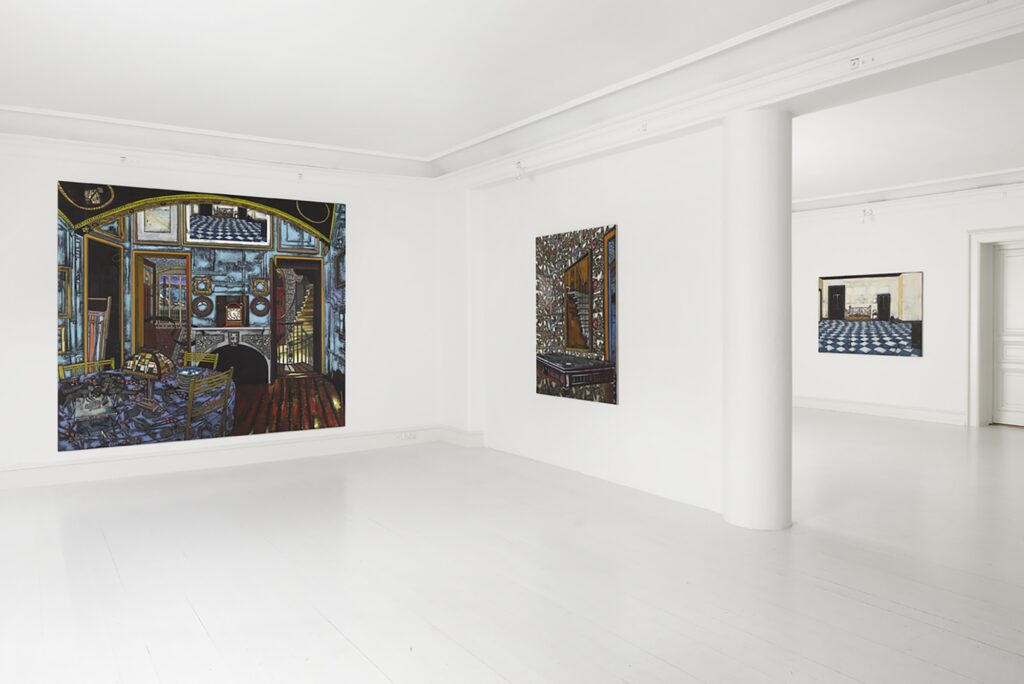
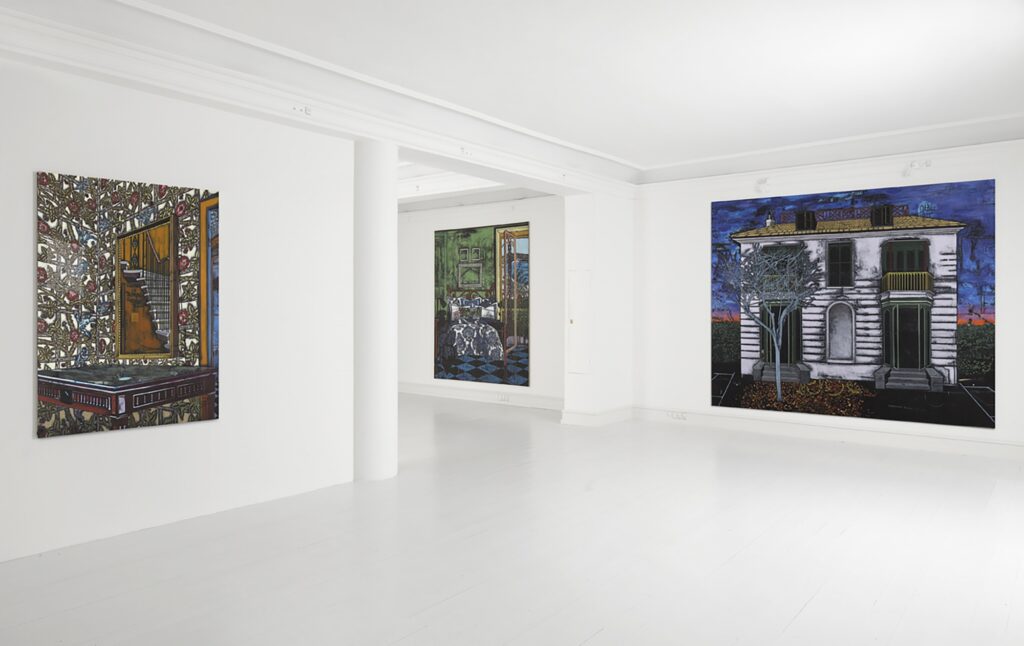
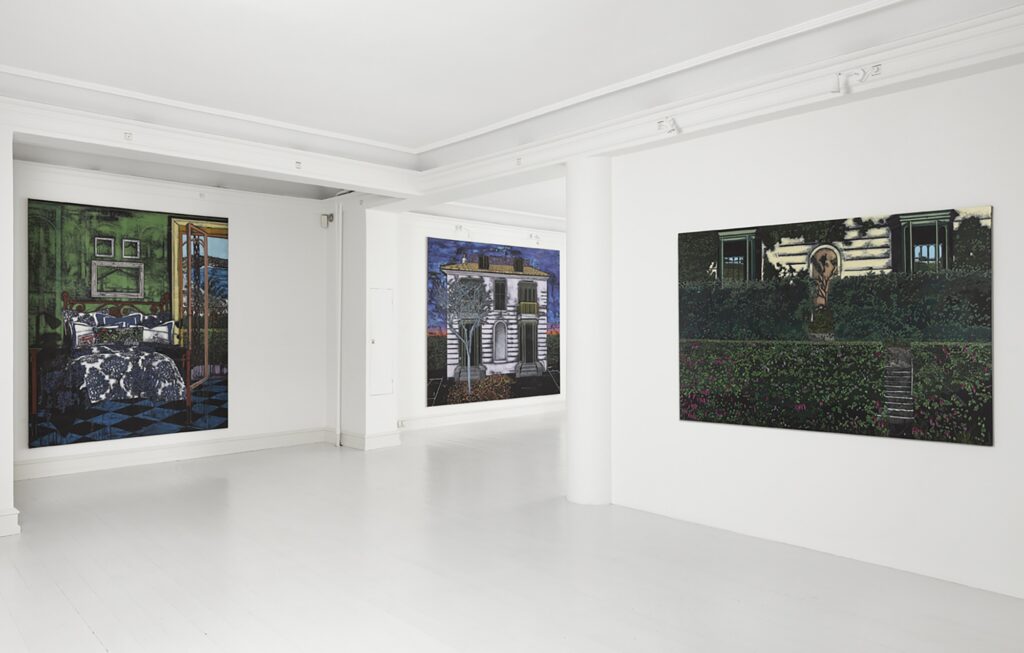
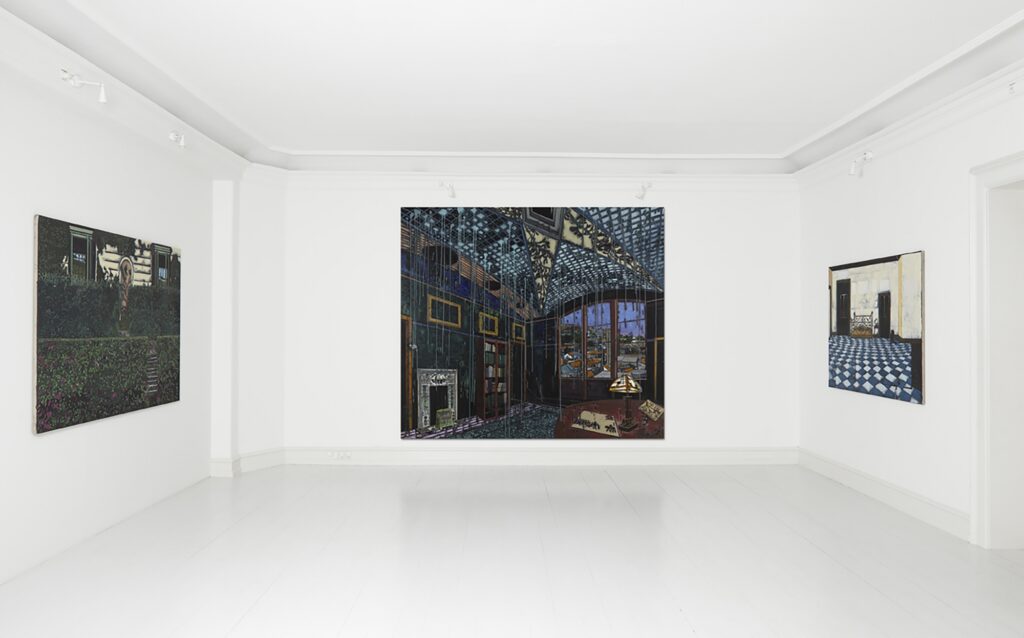
”Nothing, it seemed, could survive the flood, the profusion of darkness which, creeping in at keyholes and crevices, stole round window blinds, came into bedrooms, swallowed up here a jug and basin, there a bowl of red and yellow dahlias, there the sharp edges and firm bulk of a chest of drawers. Not only was furniture confounded; there was scarcely anything left of body or mind by which one could say, “This is he” or “This is she.””
Virginia Woolf – ”To the Lighthouse”
The thematic focus of Jesper Christiansen’s new series of paintings is Virginia Woolf’s novel “To the Lighthouse” from 1927. This is not the first time Christiansen has employed a literary work as the basis for an exhibition; he has previously painted works inspired by the writer Marcel Proust for example.
Woolf’s novel is now considered to be a masterpiece of modern literature. The book’s main characters are the Ramsay family and their various friends. The action plays out in the Ramsay family’s summer home on the Scottish Isle of Skye, which in the book they visit twice at a ten year interval.
Christiansen’s title for the exhibition, “Time Passes” comes from the novel’s middle section where the leading role is taken by the house itself. The building takes a somewhat secondary role in the first and final sections of the novel when the family and their guests are staying there, while it is the empty house and the time that passes that forms the primary focus of the book’s middle section.
The paintings are therefore free of people, focusing instead on the house and its interior. The house depicted in Christiansen’s pictures is a faithful representation of the house in Woolf’s novel – which was in fact Woolf’s own family summer house, although in reality it lies in the southern English town of St. Ives in Cornwall.
The pictures are filled with patterns and structures from the interior and the garden. Together the works combine to form vibrant, colourful landscapes. The patterns and colours do, however, lie set against the black foundation which here and there is left untouched. It is precisely this penetration of darkness that forms the common theme of Woolf’s novel and Christiansen’s paintings. The darkness flows through the rooms, changing them continually. It lies behind the motif at all times and can cause it to disappear, and the black background simultaneously lends the colourful motifs presence and endows the images with a sense of absence.
Photo credits: Jan Søndergaard